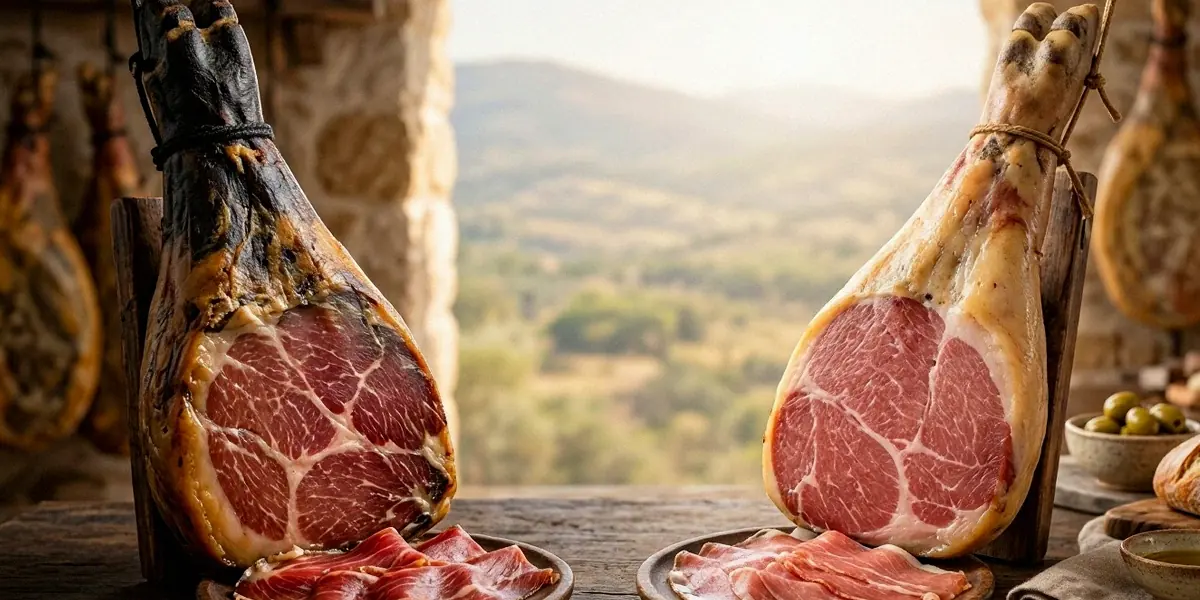
Jamón Ibérico vs Jamón Serrano: What’s the Difference?
We still remember the first time we stood at a deli counter in the UK, staring at two nearly identical legs of Spanish ham and wondering which one deserved a place in our basket. One was priced like a weekly shop, the other like a special occasion. Both looked magnificent. If you’ve ever found yourself in the same spot — squinting at labels, unsure whether you’re paying for genuine quality or just a fancier name — this guide is for you. We’re going to break down exactly what separates jamón ibérico from jamón serrano, from the breed of pig to the curing time, the flavour, and what you should realistically pay in the UK.
What Exactly Are Jamón Ibérico and Jamón Serrano?
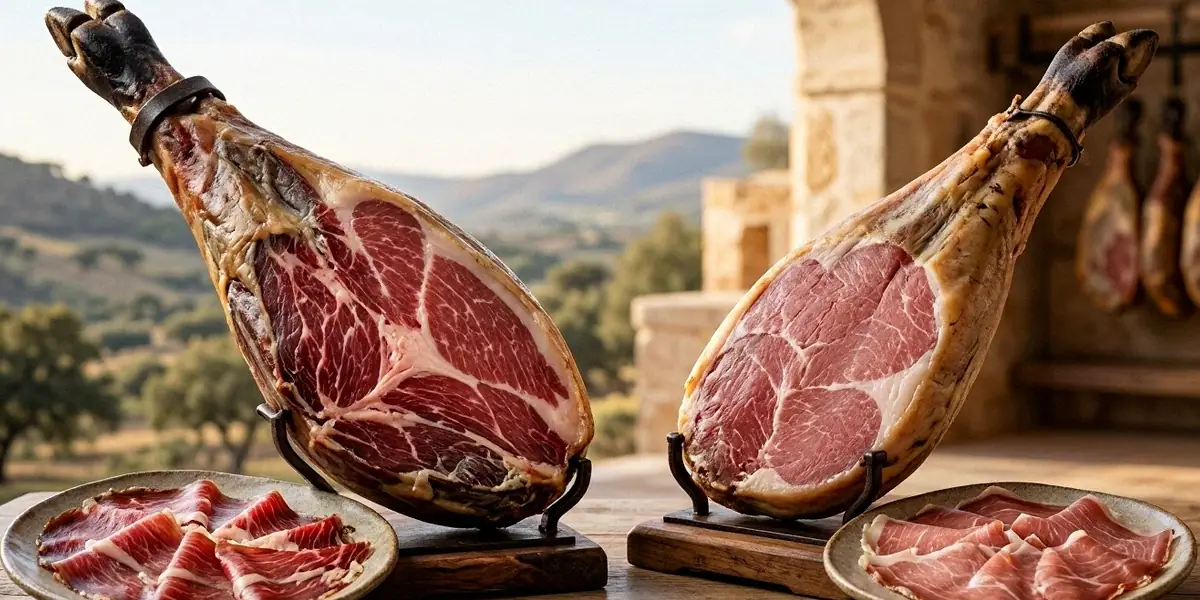
Both are dry-cured whole legs of pork, produced in Spain using a method that dates back centuries: salting, washing, and then hanging the leg in cool, dry air for months or even years. The difference starts with the pig. Jamón ibérico comes from Iberian pigs — a native breed with dark skin, sparse hair, and famously black hooves, often raised free-range on the dehesa, the sparse oak woodland of southwestern Spain. Jamón serrano comes from white pigs such as Landrace or Large White, the same breeds you’ll find on most European farms.
Only ibérico carries the black label hierarchy that governs quality: Cebo (grain-fed), Cebo de Campo (grain-fed but with some outdoor roaming), and Bellota (acorn-fed, free-range). Serrano has no equivalent tiering — it’s a single, consistent product defined by its curing method rather than the pig’s diet.
The Iberian Pig: Breeds and Black Hooves
The Iberian pig is genetically distinct, with a capacity to store fat that’s unusually high in oleic acid — the same monounsaturated fat found in olive oil. That’s why ibérico melts on the tongue rather than feeling greasy. To be legally sold as jamón ibérico, the pig must be at least 50% Iberian breed, and the best producers work with 100% purebred stock. The black hoof (pata negra) is a useful shorthand, but it’s not a guarantee of quality on its own — plenty of cebo-grade ibérico has a black hoof too.
Serrano: Spain’s Everyday Mountain Ham
Serrano literally means “from the mountains,” a nod to the high-altitude curing houses where the ham was traditionally made. It’s the ham you’ll find in every Spanish bar, sliced into a bocadillo or draped over a plate of olives. It’s reliable, affordable, and produced at scale across regions like Castilla y León, Aragón, and Cataluña.
Curing, Production, and Protected Status
Curing time is where the two hams really diverge. Serrano is typically cured for 7 to 16 months, depending on the size of the leg and the producer. Ibérico takes far longer — 24 to 48 months is standard, and bellota-grade legs often go beyond that. The extra time allows the fat to render and develop the deep, nutty complexity that defines good ibérico.
Both products carry protected status, but different kinds. Jamón Ibérico de Bellota is protected by DOPs (Denominación de Origen Protegida) such as Guijuelo, Jabugo, and Dehesa de Extremadura. Jamón Serrano holds TSG (Traditional Speciality Guaranteed) status in the EU and UK, which protects the production method rather than a specific region.
How Long Does Each Ham Cure?
- Jamón Serrano: 7–16 months, typically 12
- Jamón Ibérico de Cebo: 24–30 months
- Jamón Ibérico de Cebo de Campo: 30–36 months
- Jamón Ibérico de Bellota: 36–48 months, sometimes longer
DOP and TSG Labels You’ll See in the UK
When you’re shopping, look for the DOP stamp on ibérico — Guijuelo, Jabugo, and Dehesa de Extremadura are the three you’ll encounter most often on UK shelves. For serrano, the TSG logo confirms the ham was made following the traditional method. These labels aren’t marketing decoration; they’re legal guarantees backed by EU and UK protected food name schemes.
Flavour, Texture, and Fat Content
Put a slice of each on your tongue and the difference is immediate. Ibérico is nutty, intensely savoury, and heavily marbled with fat that melts at room temperature. Serrano is leaner, saltier, and firmer, with a cleaner, more straightforward pork flavour. Neither is “better” — they’re built for different jobs.
Ibérico: Nutty, Sweet, and Heavily Marbled
Bellota-grade ibérico tastes of acorns and herbs, with a sweetness that lingers. The fat is the star: rich in oleic acid, it liquefies on contact with your hand, which is why ibérico is served at room temperature and eaten slowly. Cebo-grade ibérico is milder and less complex, but still noticeably richer than serrano.
Serrano: Salty, Lean, and Reliable
Serrano is the workhorse. It’s salty enough to wake up your palate, firm enough to slice cleanly, and versatile enough to use in cooking — wrapped around dates, layered into croquetas, or chopped into a sofrito. It won’t stop conversation the way a good bellota does, but it will never let you down.
Price and Value: What You’ll Pay in the UK
Here’s where the gap becomes real. Serrano sits at around £15–£25 per kg for pre-sliced packs or freshly carved portions. Ibérico de Cebo runs £30–£50 per kg, and bellota jumps to £60–£120+ per kg depending on the DOP and the producer.
On the high street, Waitrose and Marks & Spencer stock jamón serrano in their deli counters across the UK, and Tesco carries pre-sliced packs in most large stores. Ibérico is a different hunt. Brindisa in Borough Market, London, is a leading UK supplier of jamón ibérico and a great place to taste before you buy. Online, Basco Fine Foods is a UK retailer specialising in Spanish jamón and cheeses, and they ship nationwide.
Budget-Friendly Serrano
For everyday eating, cooking, and feeding a crowd, serrano is the sensible choice. A 100g pack of pre-sliced serrano from a supermarket deli will set you back £3–£5, which is enough for a generous tapas board for two.
Splurge-Worthy Ibérico
Ibérico is a treat, and it should be treated like one. Buy it hand-carved where possible — pre-sliced ibérico loses its fat-melting magic quickly. A 100g portion of bellota at £8–£15 is a genuinely memorable experience, especially alongside a glass of something cold and dry.
How to Serve and Pair Each Ham
Both hams should be served at room temperature, sliced paper-thin. Cold ham tastes of nothing; warm ham tastes of everything. Take them out of the fridge 20–30 minutes before serving.
Tapas at Home: Building a Board
For serrano, pair with Manchego, marcona almonds, and a bowl of good olives. For ibérico, go richer: aged Spanish cheese like a 12-month Manchego or a Torta del Casar, pan con tomate, and a few drops of good olive oil. Ibérico is also best eaten alone, one slice at a time, so you can actually taste it.
Wine and Sherry Pairings
Serrano works beautifully with a dry fino or manzanilla sherry, or a cold Spanish lager like Estrella Damm. Ibérico deserves a Rioja Reserva, a glass of cava, or an oloroso sherry — something with enough weight to stand up to the fat without overwhelming it.
Which One Should You Buy? Our Verdict
If you’re building a tapas night for friends, cooking with ham, or just want something great on a Tuesday, buy serrano. If you’re marking an occasion, exploring Spanish food properly, or want to understand what all the fuss is about, buy ibérico. And if you’re buying ibérico for the first time, a cebo de campo offers the best balance of quality and price — noticeably better than cebo, without the bellota price tag.
Everyday vs. Occasion
Think of serrano as your house ham and ibérico as your celebration ham. Both belong in a UK kitchen that takes Spanish food seriously.
Our Top Picks for UK Shoppers
- Everyday serrano: Waitrose or M&S deli counter, freshly sliced
- Pre-sliced convenience: Tesco Finest jamón serrano
- Ibérico in person: Brindisa, Borough Market, London
- Ibérico online: Basco Fine Foods, delivered UK-wide
Both hams have a place in a UK kitchen. The best way to learn the difference isn’t to read about it — it’s to buy a small portion of each, slice them side by side, and taste them with friends. That’s when the penny drops.
FAQ
Is jamón ibérico the same as pata negra?
Not exactly. “Pata negra” refers to the black hoof typical of Iberian pigs, but it’s an informal term. Only ham from at least 50% Iberian breed pigs can legally be called jamón ibérico, and the black hoof alone doesn’t guarantee quality or grade.
Can I cook with jamón ibérico?
You can, but it’s a waste of money. The fat that makes ibérico special melts away in a hot pan. Use serrano for cooking — it holds its shape and flavour better — and save ibérico for eating raw.
How should I store jamón at home?
Keep pre-sliced ham in the fridge, wrapped tightly, and bring it to room temperature before serving. If you’ve bought a whole leg, store it in a cool, dry spot and cover the cut surface with a clean cloth or a thin layer of olive oil.
Is jamón serrano the same as prosciutto?
They’re similar in method but different in origin and flavour. Prosciutto is Italian and typically milder and sweeter. Serrano is saltier, firmer, and usually cheaper — which is why it’s the go-to for Spanish tapas at home.
Where can I buy jamón ibérico in the UK?
Brindisa in Borough Market is the best-known physical retailer, and Basco Fine Foods is a reliable online option. Some Waitrose and M&S stores carry ibérico in their deli counters, though serrano is far more widely stocked.




Post Comment